Wednesday, May 9, 2012

Fairbanks; A Big Little Town on the Chena River

Creamers Field Wetlands in Winter
We dropped from the Alaska Range into the interior of Alaska on our way to Fairbanks. It is a wonderfully gritty little town with aspirations of being a bigger town. Compared to Anchorage, Fairbanks is in another world with colder colds, and hotter hots—generally a more extreme climate.
We have been trying to paint a picture of our travels that suggests we are really roughing it, rubbing sticks together to start fires and foraging for food in the wild. Well, actually it hasn’t been that bad and today, I must confess, we are living quite well. We arrived in Fairbanks and stopped at a respected RV park on the Chena River, which bisects town. Most parks, even if they were not fully open, have let us hook to power and spend the night. Not here. The owner made it clear she was not open until May 17th and we should scram, thank you very much.
We thought about the situation for seven seconds and checked into a wonderful little motel with pillow top beds and free breakfast. My how quick we gave up living the wilds. Then for dinner, at the suggestion of a shop keeper, we traveled five miles into the nearby hills for a wonderful Italian dinner at The Vallata. It was not hardtack and venison. This was a five star place for a denim clad crowd.
We have done the museums and quilt shops of Fairbanks and plan to head down the Alcan at sunrise—or sometime after sunrise. We shall see.
CLICK ON PHOTOS TO ENLARGE

Phyllis in Fairbanks
The Church were Phyllis was wed, June 1940

In June of 1940 Kathy’s mother, 20 year old Phyllis Feroe, stepped off of an Army transport in Seward and into another world. Born and raised in Seattle she had previously traveled no further than California. Now she was in Alaska Territory, alone, on her way to meet her fiancĂ©, Army Lt. Marvin Walseth, and be married.
A friend of Marvin’s met her at the dock and flew her to Anchorage, for the night. It was her first small plane ride. The next day, Wednesday, she flew on to Fairbanks where she met Marvin and was put up with two girls who shared an apartment in his building. Thursday the three women gathered flowers and decorated the Presbyterian Church for the wedding. On Friday they were married.
Interior of the Church

The next 18 months were a whirlwind of activity for the young bride. She set up house first in his apartment and later in new quarters at Ladd Field (now Fort Wainwright). She taught music, led a Girl Scout troop, took classes at U. of Alaska, directed a choir in one church, sang in a choir in another, took a river boat trip down the Tanana River and entertained visiting officers who her husband would bring home with little notice.
That life ended abruptly. The Japanese attacked Pearl Harbor, dependents were sent “outside” to Seattle and, six months later Marvin was killed on a mission in his B-17 bomber over the Aleutian Islands. A story of his flying career can be found at Old Seventy.  

Phyllis and her husband on a river trip.

In 2002 Kathy and Steve escorted her folks, Phyllis and Don, back to Alaska visiting Fairbanks, Anchorage and Seward. We even found an old friend of Phyllis’ from the Fairbanks era. It was a bittersweet trip but offered an element of closure to both of them as Alaska had played such an important part of their young lives.


Talkeetna to Denali Park; McKinley Views All the Way


Mt McKinley in the cloud
            With a Talkeetna Roadhouse breakfast under our belts we headed for the Parks Highway and our next stop, Denali National Park. Denali is anchored by 20,000 foot Mt. McKinley, which is the target of hundreds of “wanna be” climbers each year. McKinley may be the highest but it is surrounded by other mountains of the Alaska Range that present an incredible vista you as you head north. Alaska has no shortage of impressive mountain peaks.
Since McKinley weather is notoriously fickle we stop at every opportunity to take “just one more picture” in case the clouds beat us to the park. We now have a goodly supply of photos of the big mountain.
Denali Park is special since most is preserved as wilderness; a single 90 mile road carves into the park and traffic is very restricted. During the summer season most guests must leave their cars outside and enter the park on a school bus for the park tour. We are the lucky ones. The buses are not running yet and visitors are scarce so we are permitted to drive 30 miles into the park. Having ridden the bus on a previous visit we really appreciated that opportunity.Views are expansive—though not of the cloud covered mountain. We are told of bears, caribou, wolves and sheep that have been seen from the road by visitors that day. We had to settle for a single moose visible only with good binoculars. But the views are worth the trip.
Caribou spotted outside of the park
Like so many places we’ve visited, the tourist facilities are just waking up. Hotels, shops and restaurants that will be crowded with cruise ship passengers in a few weeks are, like the bears of Denali, slowly coming out of hibernation.
While some park facilities are open year around, to facilitate winter camping, most businesses abandon the place. Average January temperatures of -7 degrees tend to drive summer workers to warmer climates.
Today the trek north continues with stops in Healy, Nanana and Fairbanks, the gritty “capital” of the interior

Flashback, a story of Healy Alaska, near Denali Park: The winter of 1941 my mother-in-law and her husband, Lt. Marvin Walseth, were stationed at Ladd Field, Fairbanks, Alaska. Walseth, an Army Air Corp pilot, shared this story in a letter to his father.

One winter morning Walseth’s commander and friend, Major Dale Gaffney, left Ladd in a single seat fighter plane for a 300 mile flight to Anchorage. His route would take him over a pass in the Alaska Range just south of the current Denali Park. As he approached the pass clouds descended and he decided to land while he could still see. The nearest airfield was at Healy, just north of the current Denali Park entrance.

Gaffney made a pass over the field to see if it was plowed. Seeing two tracks on the runway he concluded that someone had successfully landed before him so he came around, lowered his wheels and settled in. The next thing he recalled was being upside down, hanging from his shoulder harness in four feet of snow.

Gaffney's plane at Healy; Wheels and flaps down!
It seems the tracks he saw were made by snowshoers who had walked down the snow covered runway that morning, not another plane. He was rescued from his inverted and badly damaged plane with a sore back and injured pride.

The incident didn’t seem to impact his career. Gaffney, later promoted to General, managed the transfer of thousands of “lend-lease” planes to our Russian allies through Ladd Field.

You can read about Lt. Walseth’s all too short flying career at “Old Seventy.”

Tech Challenges: Our Chalet comes equipped with a power cord and four interior outlets. That should be fine, right? Not in the modern era. Each evening we have a need to plug in and/or recharge, a heater, laptop, two Kindles, two mp3 players, two phones, and iPad and batteries for two cameras. Eleven demands for four outlets. Who says this isn’t roughing it?

Tuesday, May 8, 2012

Talkeetna; Old Alaska at its Best

Talkeetna Alaska is a living museum of small town Alaska. On a spur road, 14 miles from the Parks Highway (which links Anchorage and Fairbanks via Denali Park,) it is worth the detour. This was our second visit to the town and both times it was sunny and Mt. McKinley was in view. We are told only about 30% of the visitors ever see the mountain due to weather. How lucky are we?
Any town with a cat for a mayor must be special and Talkeetna is special. Mayor Stubbs was duly elected by the locals and watches over town from any warm spot he choses.
The snow is nearly gone but the winter road sand remains. It’s difficult to discern the paved streets (the highway in and a few in town) from the rest. Main street looks like a Hollywood set though the old looking log buildings are truly old. There is Nagley’s store, in a log building that has been moved several times. The Fairview Inn is old and I’m confident could not survive a move. But it offers a “fair” view of Mt McKinley on the outside and an interesting view of the local bar patrons on the inside.
Mayor Stubbs the Cat

Mayor's home and leading emporium

Fans of the TV series “Northern Exposure” would feel at home here as Talkeetna was the inspiration for the series that involved a New York doctor sent to a small Alaska town, a inn run by a couple of widely different ages, a locally owned radio station and a lady pilot. While the series was filmed in Roslyn Washington the characters came from the annals of Talkeetna life. For an interesting description of the town visit Australian Travel.

The Fairview Inn on the Outside

The Fairview Inn on the Inside

          The nearby airfield is busy, particularly in the summer, with “flightseeing” trips and staging climbers on Mt. McKinley for their climbs to the top. Most climbing parties begin their trek being airlifted to a mountain glacier, beginning their two week accent from there. Though it’s early May, according the park service office, there are already 110 climbers on the mountain. It’s a big place.
Anchorage is a nice urban place. But Talkeetna represents the Alaska we really enjoy.
(CLICK ON PHOTOS TO ENLARGE)

The dilemma, to eat in or out: We are equipped and stocked to eat most of our meals at our campsite. But we have found that isolates us from the locals and their stories of life in Alaska or life in general. In Mendeltna and Kodiak our servers were most enjoyable companions. Monday, in Anchorage, we shared a table with an elder from a Bristol Bay tribe who was full of fishing and freighting stories we would not have heard elsewhere. So we will continue to mix eating in with eating local when a place of interest presents itself.

In Talkeetna, based on the recommendation of locals, we chose “The Roadhouse” for breakfast. Its “Roadhouse Special,” a family style platter heaped with eggs, potatoes, meat and bread, comes with a five star rating. The cinnamon rolls and sourdough pancakes are also highly rated but I settled for the sourdoughs and they were exceptional. As for meeting people, we shared a “family style table” with two men who were in town for “bush flying” lessons. Both were experienced pilots but were in Talkeetna to learn how to land on river bars and glaciers. Most interesting!

On a sad note: A decade ago we arrived in town with friends and they and my wife opted for a flightseeing trip to Mt. McKinley. I opted for the bar at the Fairview Inn, but that’s another story. They selected an air service run by two women with the motto, "Two Babes and a Bird." Pilot Kelly gave them an incredible ride which included landing at the climbing base camp on a glacier. Sadly, on this trip, we learned that Kelly later lost her life in a flying accident near the mountain.

Saturday, May 5, 2012

Kodiak Sojourn--Sunshine, History and Fish


Kodiak Harbor
           Friday morning found us landing at Kodiak, less than one hour from Anchorage. Kodiak was on our itinerary for personal reasons (see “Don Brown in Kodiak” below) but we thoroughly enjoyed our time there seeing the sights and meeting the people.
Our arrival enthusiasm was slightly dampened by an excruciatingly slow Avis rep. With one finger he made enough keystrokes to write a novel. We are not sure what he was doing but we were the last passengers to exit the compact terminal, keys in hand. On the recommendation of a local, and after driving the wrong way for about five miles, we headed to “where the locals eat,” King's Diner. It proved to be a propitious suggestion.
At the Diner Jayne, in addition to being our server, was a one woman booster for Kodiak Island. Before the omelet arrived we had recommendations for places to visit and places to eat that would keep us occupied for the next two days. She also shared places to avoid; good advice when some roads lure you in and turn to gravel a few miles along.
Baranov Museum, Kodiak
            The Best Western Kodiak Inn allowed early check in and proved to be centrally located near the fishing fleet moorage. This town and island lives and breathes fishing. We first visited the harbor master to inquire about the status of the "Karen Jean", a fishing boat formerly owned by a friend. It was out fishing. Then, up the hill to the Baranov Museum to see the “Don Brown Collection” and other artifacts. The Kodiak Wildlife Refuge Center and Alutiiq Museum were close by as well. In a short time we had done what we came to do and were ready to move on.
While we were the only “tourists” in the area, museums were teeming with grade school kids on end-of-year field trips which gave them a certain kinetic energy.
We faced two choices for our driving tour—go east or go west. Though nearly the size of Connecticut, the Kodiak Islands are rugged and relatively roadless. We could go westerly about 40 miles or easterly, about 15 miles. We turned west.
The limited roads generally follow the coast, winding around bays, then over ridges into the next valley and around the next bay. The weather changed with each valley; sun in one, snow and rain in the next, cloudy and dry in the next. On Friday alone we experienced a range of weather that, we are told, is typical of the area. The only constant was the temperature, low 40’s most of the day.
The scenery is spectacular. Rugged, snow covered hills loom over the coast, hidden when cloudy and sparkling when the sun shown bright. The hills still wear winter brown but will likely spring to green with longer days and warmer weather. The sea was barely rippled but the beaches bore evidence of winter storms that must sweep the islands.

          We were surprised at the end of our drive to encounter the Kodiak Launch Complex, an extensive facility for the launching of satellites. I have visited their web site but am still unclear why one would travel to Kodiak Island and then 40 miles down a winding road to reach a missile launch site. But then physics was not my strong subject and I’m not into orbits.
On the return, on Jayne’s recommendation, we stopped at the Olds River Inn for dinner. This place is 20 miles from anywhere. Why it’s there and why is succeeds I don’t know but the food was great and owners were typically Alaskan; gracious and friendly. I think everything but the napkins was homemade and delicious.
Saturday we turned east, toward the Fort Abercrombie State Park which sits on a high rock promontory, at one time guarding the entrance to Kodiak Harbor. We took advantage of the brilliant sunshine to hike the extensive trail system in the park, enjoying the views and exercise.

Sashimi in Kodiak

The Kodiak Military History Museum, housed in an old ammunition bunker, was well worth the visit. Staffed and maintained by a volunteer crew it contains professional exhibits focused on the islands World War II efforts. We were lucky as it opened for the season the day we visited.
Visited the King’s Diner again for lunch and a dinner recommendation from our guide, Jayne. The Old Power House Restaurant was her choice. Sushi in Kodiak? Again it was a good recommendation for a place off the beaten track.
Now it’s back to Anchorage and the waiting Chalet. No more motel beds for a while.

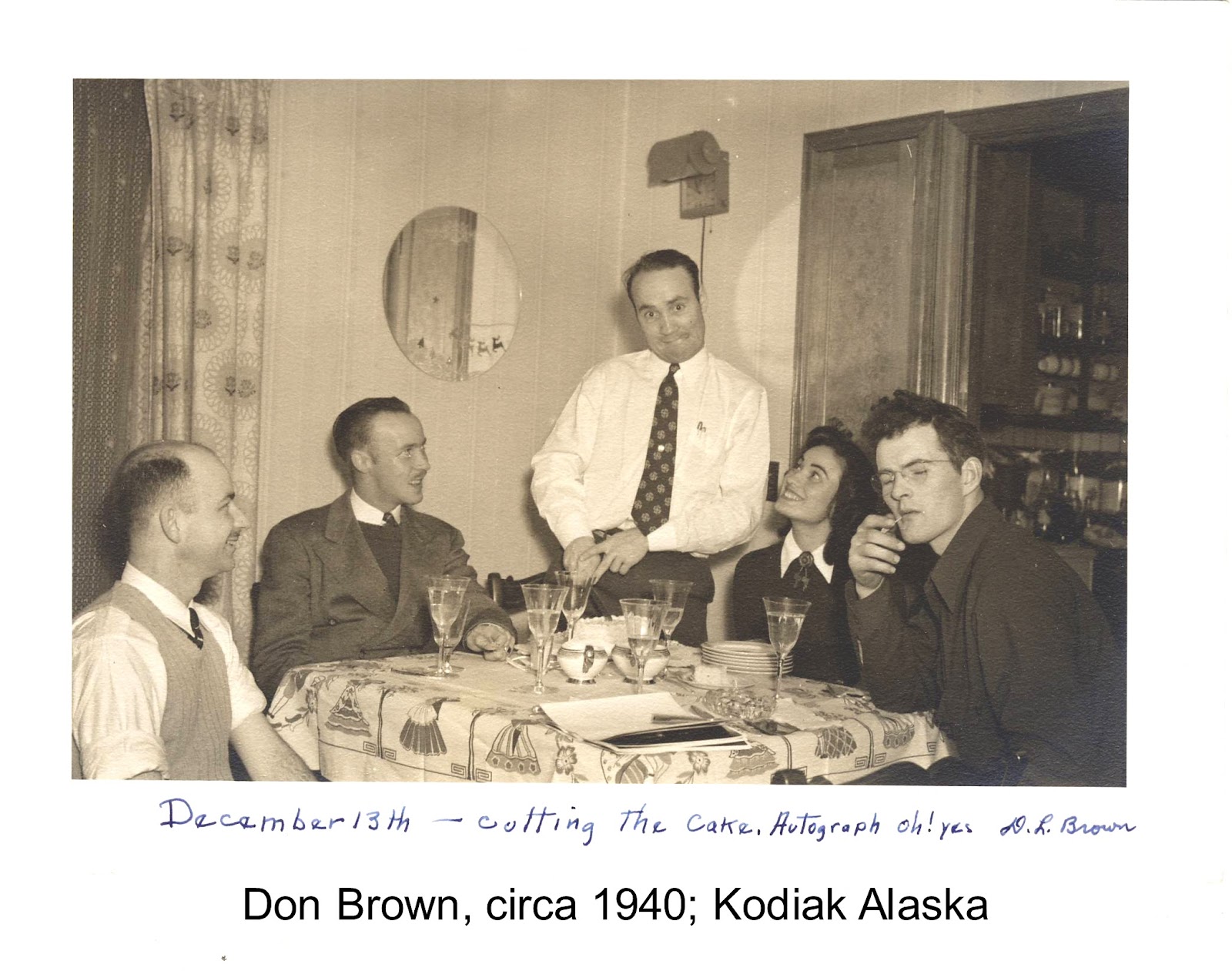
Don Brown in Kodiak: In 1940, with a business degree from the U. of Washington in hand, Kathy’s father, Don Brown, embarked on a big adventure—he took a job in Kodiak Alaska and headed north.
Jobs were scarce between the Great Depression and World War II so an office job with Simms-Drake Construction was appealing. Simms-Drake had a contract to construct a Navy Base on Kodiak Island and had import all the materials and people needed for the job. Don traveled by steamship to Seward and then transferred to a second ship for the trip to the island. He didn’t realize he would be there for three years.

Don made lifelong friends during that time; Larry Gourlie, Neal Mitchel, Marty Cordes to name a few. The war scattered the friends but, when it was over, Don stayed in touch with many of them his entire life. They are all gone now.

When the war came to Alaska, June of 1942, contractor personnel were enlisted in the defense of the Island. Each was issued a Springfield rifle, dating from World War I, and seven rounds of ammunition. Thus armed they were to repel any invasion attempt. No attempt was made.
In 1943 Don received permission to leave Kodiak as a crew member of a Fish and Game ship and made it back to Seattle where the Army rejected him for service due to the flat feet he developed running barefoot on his farm as a child.
In 2008 Don donated his collection of photos from that time to the Baranov Museum in Kodiak where they now reside.
Don never returned to Kodiak but it’s his memory that draws daughter Kathy there now. Little of the Kodiak he knew remains—it was destroyed by the 1964 earthquake and tsunami. He would be pleased to know she made the trip.

Kodiak Weather: After three days in Kodiak we may not be qualified to talk about the weather but, based on personal experience and talks with locals, here goes. We have experienced the following:
+  Sunny: Any sun counts and we have had a great deal. A few scattered clouds can be ignored. If you can see the sun it’s sunny.
+  Light rain/mist: You can’t see it but you are wet when you come in. Wipers on intermittent, intermittently.
 +  Rain: You can see it. Wipers on low.
+  Heavy/torrential rain: You can see, feel and hear it (as in pounding on the car.) Wipers on full.
+++  Wind may be added to all the above but we did not have to deal with wind…yea!

Thursday, May 3, 2012

No Sun, No Crowd, No Problem--Haines Junction to Anchorage

            Lazy Tuesday, we were the last of three tenants to uproot and pull out of the Kluane RV park and head up our first stretch of the real Alaska Highway. In this stretch there are just miles and miles of miles and miles. Views were expansive, horizontally, but limited vertically by the clouds that clipped off the top of the surrounding mountains.
Few places are open this time of year so we took advantage of each to meet the locals and hear their tales. They are usually very friendly and enjoy speaking with travelers who express a sincere interest in their lives and local history. Stopped to fill coffee cups (not to be confused with lattes!) at Burwash Landing and in 20 minutes learned the weather and history from the owner and met the local snow plow crew, who stopped for breakfast.
We passed from British Columbia into the Yukon Territory before returning to the USA near Beaver Creek, Yukon Territory.
After what seemed like a long day we arrived in Tok, a major crossroads and one of the biggest communities in this region. Fast Eddies provided a dinner spot and the Sourdough RV park gave us a place to set up the chalet. Somewhat surprised we awoke to a 23 degree temperature (60 in the chalet) and a dusting of snow. Spring in Alaska!

<><>
<>
<><>
Kathy, waiting to be served.

Wednesday we left the Alaska Highway, it continued on toward Fairbanks, while we turned south on the Tok Cutoff toward Anchorage. That turned into the Glennallen Highway and landed us at the Mendeltna Creek Lodge, near nothing in particular at mile 153. The place wasn’t really open but the owner sent us into the snow covered RV lot where we found a home for the night. No one joined us!
Thursday morning was a repeat of Wednesdays—27 degrees and a dusting of snow. Rather than cook in we folded up the chalet and joined the owner for breakfast in the Lodge by a roaring fire. Good coffee and conversation.

The Chef at Work
Now we are settled in Anchorage, ready for a Friday flight to Kodiak and the next stop on the journey.

Weather Thoughtlets: We expected interesting weather on this trip and so far it hasn’t been a disappointment. Given the weather we understand why there are so few people on the road and most of the tourist stuff on the Alaska Highway is still boarded up. But, looking on the bright side:
* We don’t need reservations in RV parks.
*We don’t need to purchase ice. (Our extra drinking water is in the ice chest to keep it from freezing in the car!)
*We are not in a tent. (Our Chalet heating keeps us comfy.)
Mendeltna Lodge RV Park in the AM

*The weather is improving and should continue to do so as we head west and north.
*Everyone we meet is very friendly. (Perhaps they just want to be nice to the crazy people.)
*Only one mosquito in seven days, a large but lethargic one that fell victim to my swift reaction time.

 iPad Woes: When I purchased my iPad I had a choice for wireless; Verizon or AT&T. I chose Verizon. Good choice? I guess, if you don’t plan on traveling to Alaska. Verizon has yet to recognize the 49th state. At least wifi is available at most RV parks and motels. But in between, your iPad is best used for solitaire or as a cutting board where connectivity is concerned.


Tuesday, May 1, 2012

Alaska Highway at Last


click to enlarge

On Monday the good ship Columbia deposited us in the small town of Haines, Alaska for the real start of our driving trip. We headed north, crossed into British Columbia and, finally, settled in a little place called Haines Junction, Yukon Territory, our first stop on the iconic Alaska Highway. The Alaska Highway (aka Alaska Military Highway, Alaska-Canada Highway and ALCAN) represents an amazing feat of engineering and construction. 
Constructed in 1942 as a land link to Alaska during World War II the road traverses 1523 miles from Dawson Creek, British Columbia to Fairbanks, Alaska. History buffs can click HERE for details but suffice to say, it was a herculean task over some of the most challenging real estate in North American. 11,000 U.S. troops fought mud, ice, permafrost and mosquitoes to complete the task in just seven months, less time than it takes to write an environmental impact statement today.
Over the past 70 years wooden bridges have been replaced with steel and concrete, curves have been straightened, slopes have been flattened and gravel replaced by asphalt so the current traveler faces little challenge. But it is still a long, long road and, except for summer months, services are widely spaced.
Our 300 mile stretch today, from Haines Junction to Tok, Alaska took us through beautiful country along the shores of Kulane Lake in weather that ranged from clouds to sun and rain to snow while keeping the temperature hovering below 40 degrees at all times.

Suggestion: I recommend a wonderful book that will give you a feel for life in small town Alaska. “If You Lived Here, I’d Know Your Name” by Haines author Heather Lende is available at Amazon.

The Reids trip north begins
A Traveler’s Tale: In 1947 my brother-in-law’s parents, Gib and Eileen Reid, loaded their worldly possessions onto a war surplus jeep with trailer and drove the muddy Alaska Highway to Anchorage and a homestead life. He was a war veteran and she was an English war bride who had never been out of England. Their story, The Reid’s 1947 Trip to Alaska, is an easy read with pictures.

Factoid: The borders between the U.S. and Canada do strange things in the north land. During our trip we will cross the border six times.

Alaska Marine Highway (Alaska Ferry); A Class Act


Nose to nose and bumper to bumper
           
Monday we arrived back on land in Haines, AK after experiencing two ferries of Alaska system. Conclusion: The Alaska Ferry system is a class act. It’s functional, not plush, but very suited to the needs of the northland. The crews we encountered were friendly and good at their jobs. They arrived and departed on time. The food, cafeteria fare on the Matanuska and cafeteria or sit down dining on the Columbia, was reasonably priced and very good.
Our experience boarding the Columbia in Juneau demonstrates their efficiency.
Last cars, backing on the ferry.

The car deck was originally filled in Bellingham, Washington. Then vehicles came off and on at stops along the way. When they arrived at Juneau they needed space for vehicles with reservations from Juneau. Somehow, someway, someone had calculated the space needed, with all the departures and added vehicles since Bellingham.
At 0530 the boarding crew began studying the vehicles waiting to board—how high, how long, etc. Sitting on the dock were an array of cars, trucks, campers and semi-trailers. When the boarding began they selected vehicles from the lines, like one selects pieces for a puzzle
Our car and trailer rig, 33 feet in length, was pulled from the middle of the line and sent aboard where we ended up in a lane facing a motor home. We filled the last space in the lane perfectly. 
Near the end of the loading they began backing cars onto the boat as there would be no place to turnaround later. To fit them all this car moved a little to the left. This truck went back six inches. This camper pulled forward a smidge. In one case a young man was trapped in his car with no room to open a door. Another vehicle moved forward and an escape was executed.
In the end, the last cars in line backed down the ramp and filled the last spaces on board, the ramp raised, the door closed and we were on our way.
Clear of the yellow line the door can now close with "feet" to spare.

There should have been high fives all around for a job well done but, to the loading crew, it appeared to be just another day on the job.
I found it impressive. Alaska should be proud of their marine highway system.


Thoughtlet: Toyota Can’t Find Alaska
Our 2010 Toyota Highlander came equipped with a wonderful in-dash GPS system. It can find the smallest roads in the contiguous 48 states and Canada. But it can’t find Alaska.
Before departure I called the dealer to update the software and add Alaska. Sorry, I was told. For Toyota Alaska didn’t exist prior to 2011. If I wanted Alaska on the GPS I needed to purchase a new car.
What a conundrum—new car or new map from AAA. AAA won and now we must depend on paper rather than electronics to get around the 49th state.